
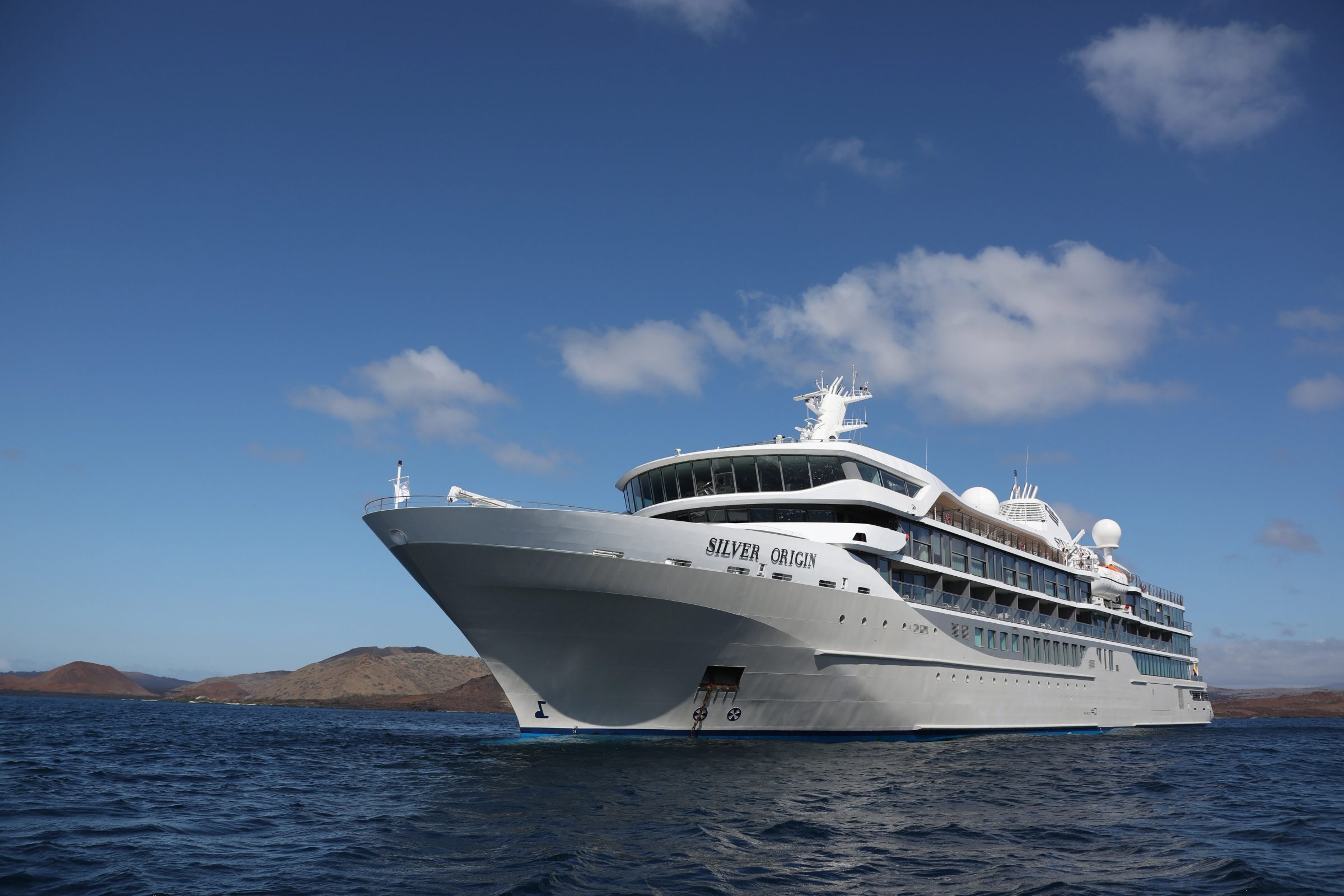
7 nights · 12. February - 19. February 2028 · San Cristóbal → San Cristóbal
Seven nights aboard Silver Origin cross the Galápagos islands from San Cristóbal through a sequence of volcanic landscapes and endemic wildlife colonies. The 100-guest vessel sails only in this archipelago, with every landing made by Zodiac with licensed national park guides.
Scroll along the route. Tap a port for details.
San Cristóbal is the oldest inhabited island in the Galápagos and home to the capital Puerto Baquerizo Moreno. First encounters with the Galápagos ecosystem: curious sea lions on the jetties, blue-footed boobies and giant tortoises in the national park.
Kicker Rock (León Dormido) is a split volcanic cone rising from the sea near San Cristóbal. Hammerhead sharks, sea lions, Galápagos turtles and rays swim through the channel between the rocks - a diver's paradise.
Prince Philip's Steps on Genovesa are a lava-rock stairway leading to a plateau that astonishes: tens of thousands of storm petrels, short-eared owls and red-footed boobies nest here. The owls hunt the petrels by day, animal behaviour that can scarcely be observed anywhere else in the world.
Darwin Bay is a collapsed caldera the ship can sail straight into. The beach is dotted with red frigatebirds, red-footed boobies and Nazca boobies - all without any fear of humans. Snorkelling brings encounters with hammerhead sharks.
North Seymour is one of the most species-rich small islands in the Galápagos. Blue-footed boobies perform their characteristic courtship dance right beside the walking trail, while frigatebirds with inflated red throat pouches sit on the bushes - all at arm's length.
Sullivan Bay on Santiago shows recently solidified pahoehoe lava - a smooth, wave-like surface like a frozen sea. Marine iguanas, sea lions and Galápagos penguins populate the shores of this dramatic volcanic landscape.
The Bolívar Channel between Isabela and Fernandina is one of the most biodiverse stretches of sea in the Galápagos. During the passage, whales, dolphin pods, Galápagos penguins and seabirds can be observed - one of the Pacific's most striking ship transits.
Punta Mangle lies on Fernandina's east coast and offers calm mangrove channels where flightless cormorants and Galápagos penguins can be seen on the water. The clear waters allow for excellent snorkelling.
Punta Moreno features solidified lava fields with flamingos in crater lakes and marine iguanas in the lava fissures. The contrast between the black lava field and the emerald green water of the crater lakes is unique.
The Santa Cruz Highlands are home to the El Chato tortoise reserve and free-ranging giant tortoises in their natural habitat. The lava tunnels - underground caves formed by lava flow - can be explored on foot. In the rainy season the highlands stay lush and green.
The Fausto Llerena Breeding Center (formerly the Charles Darwin Research Center) in Puerto Ayora is the world's most important breeding station for Galápagos giant tortoises. Many subspecies were saved from extinction here; the famous "Lonesome George" (last Pinta tortoise) lived here until his death in 2012.
Gardner Bay on Española hosts one of the largest sea lion colonies in the Galápagos and is a nesting ground for the waved albatross. Snorkelling in the turquoise water brings encounters with playful sea lions.
Punta Suarez on Española hosts the world's largest colony of waved albatross and endemic Hispaniola marine iguanas. The "Blowhole" - a hole in the lava cliffs that shoots water metres into the air - is a spectacular natural spectacle.
San Cristóbal is the oldest inhabited island in the Galápagos and home to the capital Puerto Baquerizo Moreno. First encounters with the Galápagos ecosystem: curious sea lions on the jetties, blue-footed boobies and giant tortoises in the national park.
Cerro Brujo is a white sand beach on San Cristóbal with sea lion colonies, snorkelling and turquoise water. The hiking trail up the hill offers panoramic views across the north-east of the archipelago.
San Cristóbal is the oldest inhabited island in the Galápagos and home to the capital Puerto Baquerizo Moreno. First encounters with the Galápagos ecosystem: curious sea lions on the jetties, blue-footed boobies and giant tortoises in the national park.
On your signal we will hold your preferred suite for you, without obligation.